
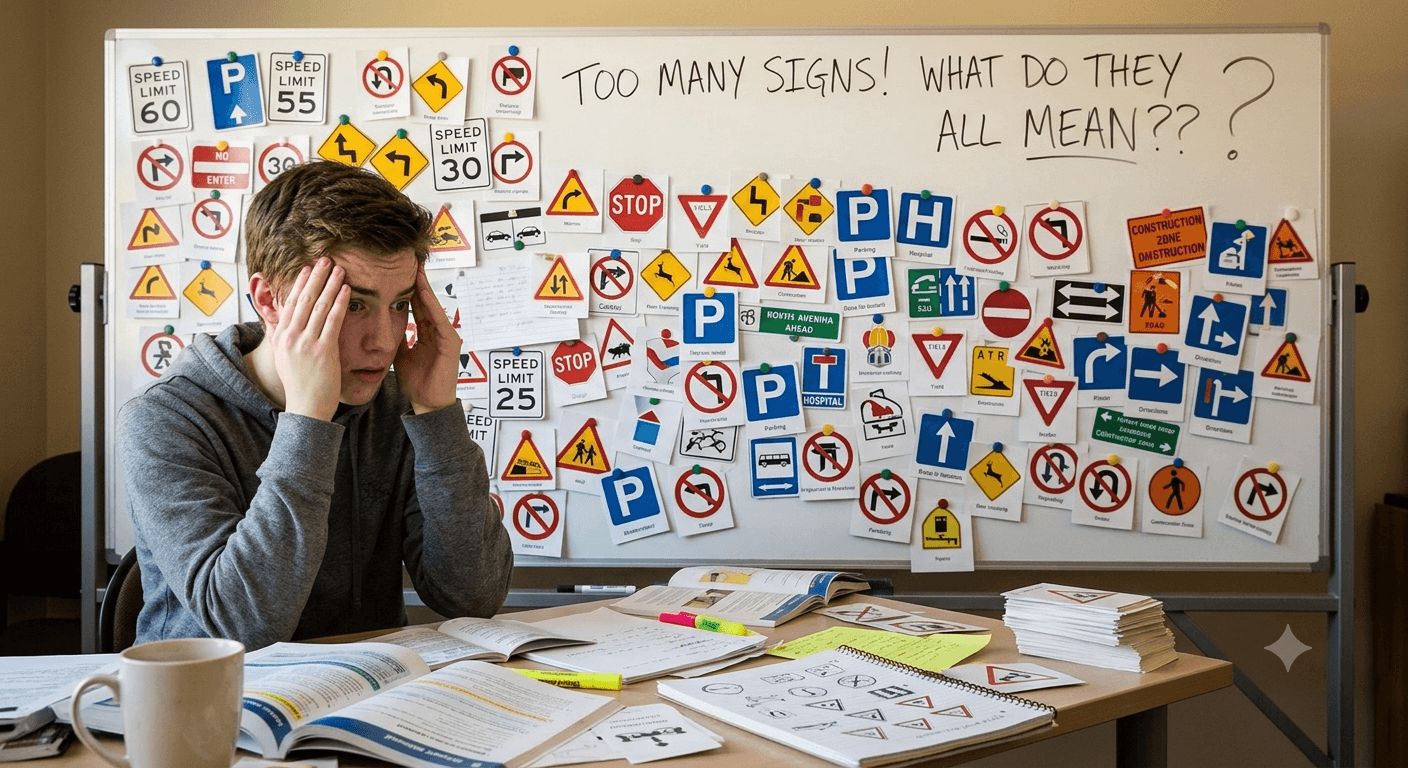
Traffic Signs Explained: Every Sign You Need to Know Before Your Driving Theory Test
Habib Akande
As the UK government’s Know Your Traffic Signs guide emphasizes, “Traffic signs play a vital role in directing, informing and controlling road users’ behaviour… [so] knowledge of traffic signs [is] essential… not just for new drivers or riders needing to pass their theory test, but for all road users”. In practice, each sign’s shape and color give clues (covered below) so you don’t miss a stop or a hazard. In this guide we’ll explain the tricky signs, why they matter on real roads, common test pitfalls, and clever memory tricks.
Decoding Shapes and Colors
Most signs follow simple shape/color rules, so you can figure out an unfamiliar sign even if you haven’t memorized it. For example:
- Triangles (red-bordered) warn of hazards ahead, e.g. sharp bends, junctions or animal crossings.
- Circles give orders: blue circles mandate actions (like “turn left” or “keep right”), while red circles or rings forbid actions (like speed limits or “no entry”).
- Rectangles (blue or green) are usually informational or directional signs (e.g. route markers, parking info).
- Exceptions: The STOP and GIVE WAY (Yield) signs have special shapes to stand out. A Stop sign is an octagon; a Give Way sign is an inverted triangle. These unique shapes mean you must obey them absolutely.
These rules give you a head start on any sign. Even if you can’t remember a graphic, you know, say, that any red-ringed circle is prohibitive and any red-triangle sign warns of a danger.
Commonly Misunderstood Signs
Some signs still trip learners up. Here are a few big ones to get right:

Give Way (Yield) Sign: This red inverted triangle means don’t automatically barge through. You must give priority to traffic on the main road. In practice, if the junction is clear you can go, but if cars or pedestrians are approaching you must stop and wait. (In the U.S., this is the Yield sign.) In other words, “Yield signs indicate that you must give the right of way to traffic on the intersecting road. If the way is clear, proceed with caution. If not, come to a complete STOP”. Learners often hesitate here, but remember: treat it seriously or you’ll fail your theory.

STOP Sign: This red octagon means just that, stop completely at the white line or before the junction. Some students roll through (“slow down” instead of stopping), but this is illegal. Always come to a standstill (about 2–3 seconds) and only move off once the way is clear. Treating a Stop like a Yield is a classic test mistake.
No Overtaking: A circular white sign with a red border showing two cars (one black, one red) means no overtaking. In other words, you can’t pass the vehicle in front until the restriction ends.
Hazardous Loads: A cartoonish sign of a car with a lit fuse or candle means “No vehicles carrying explosives”. (It’s easy to joke about fireworks, but on the road this is serious.)
Other pitfalls: For example, two similar triangle signs warn of narrowing roads: one means both sides narrow ahead, the other means only the right side narrows. And a black-and-white checkered “flag” sign surprisingly means strong side winds ahead. These oddities appear on tests, so study the Highway Code pictures!
Memory Tricks for Traffic Signs
To lock signs in your brain, use simple mnemonics instead of cramming. For example, note that red circles forbid: the phrase “Red Ring Means No Thing” helps you remember that a red circular sign always tells you what you must not do. Likewise, you can think “Triangle = Trouble” or “Triangular Trouble” to recall that red-triangle signs warn of dangers ahead. Other tricks: flashcards (sign on one side, meaning on back) or walking around and quizzing yourself on parked-car dashboard symbols. Even silly rhymes help, a learner once used “Two lanes fray, merge away” to remember a Merge sign, or “Slippery Slide” for the Slippery Road curve sign. Regular practice is key: quiz yourself on a few each day. Over time these cues make the meaning pop out at a glance.
How Edlane Teaches Signs (No More Rote Memorization)
Traditional theory books make teens slog through lists of signs. Edlane does it differently. Its app turns learning into a game with interactive, visual lessons and quizzes, so you learn by doing. For example, Edlane’s tutorials use clear images and bite-sized explanations (no dense text), and then gamified quizzes force you to recall the sign meaning quickly. Its motto is “traffic signs, gamified”. You pick a category (e.g. car signs), study the visuals, and then play adaptive quizzes that track what you know. Over time you unlock badges and level up – all while reinforcing your memory. This active “learning loop” (see a sign, answer a question, see it again) is far more engaging than passive memorization.
By studying signs in context and quizzing yourself, you’re really learning to drive safely – not just cramming for a test. As one driving app review puts it, Edlane “turns learning into a simple, enjoyable experience” so new drivers master road rules without the headache.
Sources: Official driving manuals and guides (e.g. UK’s Know Your Traffic Signs and Highway Code) explain each sign’s meaning. We’ve also compiled common learner-driver tips and example mnemonics from driving schools and exam resources.